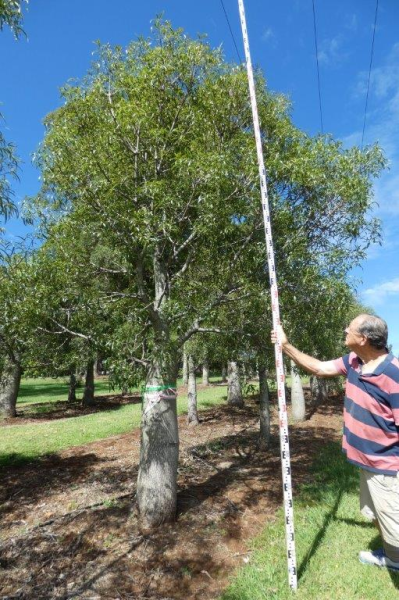
Sizes standing now
Price on application
Ex-ground specimens are quoted individually: the tree, the lift, delivery and craneage assessed for your site.
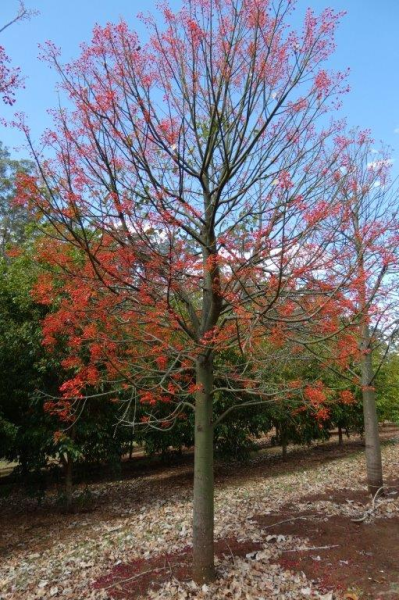
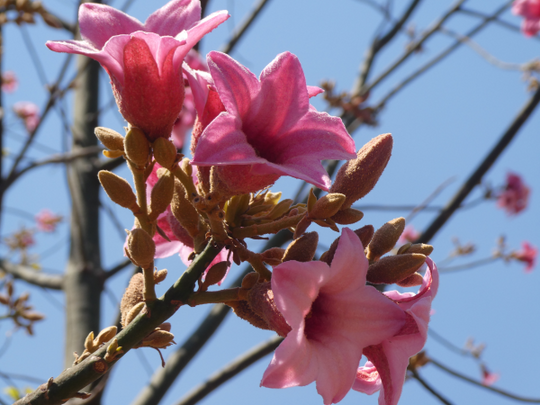
Cape chestnut carries a dense, rounded crown on a smooth grey trunk, and for a few weeks in early summer it disappears under sprays of light pink to deep mauve flowers held clear of the foliage. It is a South African tree that has earned a long tenure in Australian gardens on the strength of that display, and on the deep, even shade it gives for the rest of the year.
In the landscape
Used as a street tree, an avenue at 8–10 m centres, a lawn specimen where the rounded crown can be read whole, and as a windbreak on exposed boundaries. Roots are non-invasive, so it can be worked closer to paving and structures than most trees of its scale. At maturity it reads as a broad dome of shade with a clean single trunk beneath, good company for jacaranda, Magnolia grandiflora and clipped hedging that holds the ground plane.
Growing notes
Best in loamy, slightly acidic, free-draining soil in full sun or light shade. Frost resistant and drought resistant once established, and tolerant of coastal exposure and urban pollution. Evergreen in warm humid climates, briefly deciduous in cooler or drier sites. Growth is moderate, reaching roughly 10–15 m tall by 8–12 m wide in the ground. It grows successfully through subtropical Queensland, coastal New South Wales and warmer parts of Victoria, though flowering is heaviest where summers are warm.
This tree
| Size | Canopy width | Caliper | Standing |
|---|---|---|---|
| 4.5–5.5 m | 3.5 m | 120–140 mm | 13 trees |
| 6.0–6.5 m | 4.0–4.5 m | 200–250 mm | 25 trees |
Field-grown ex-ground at Ravensbourne Farm, root-pruned and basket-lifted, delivered and craned Australia-wide, price on application through the Shortlist.
Every numbered specimen travels with its Tree Passport: farm, row, year planted, root-management history and current measurements.